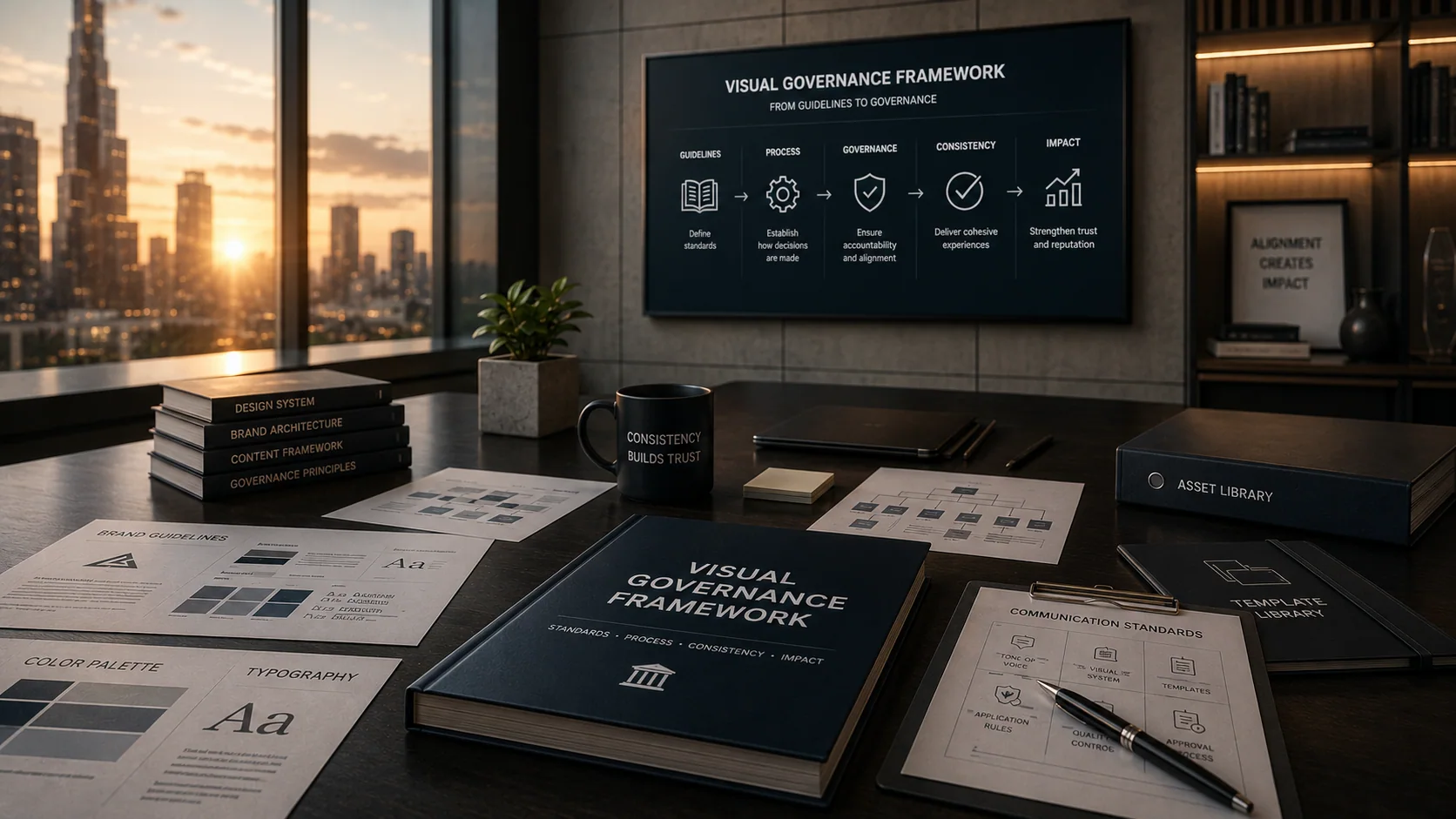
Introduction
Most organizations recognize the importance of visual consistency. They invest in logos, color palettes, typography systems, and brand guidelines to help ensure that communication remains recognizable and aligned.
Yet despite these efforts, inconsistency often persists.
Presentations differ significantly across departments. Reports vary in structure and quality. Events adopt their own visual language. Digital platforms evolve independently. Teams create communication materials using different interpretations of the brand. Over time, these inconsistencies begin to weaken clarity, reduce efficiency, and fragment organizational perception.
The problem is rarely the absence of brand guidelines. More often, it is the absence of governance.
Many organizations assume that publishing a brand manual is sufficient to ensure consistency. In reality, guidelines alone rarely change organizational behavior. They define what the brand should look like, but they do not establish how visual decisions are made, who owns those decisions, or how consistency is maintained as the organization evolves.
- Strong institutions therefore require more than brand guidelines.
- They require visual governance.
- Brand guidelines describe standards.
- Governance institutionalizes them.
- Without governance, consistency remains aspirational rather than operational.
Brand Guidelines Define. Governance Enables.
Brand guidelines remain an essential component of any visual system. They establish the foundational elements of identity, including logos, color systems, typography, imagery, and basic application rules. However, guidelines answer only part of the equation.
They answer:
- What should the brand look like?
- Which visual elements should be used?
- How should core assets be applied?
Visual governance addresses a different set of questions:
- Who approves visual communication?
- How are new applications evaluated?
- How are exceptions managed?
- How are standards maintained across departments?
- How are new initiatives integrated into the system?
- How does the system evolve over time?
Without answers to these questions, consistency often depends on individual judgment rather than institutional processes.
Growth Increases Complexity
As organizations expand, communication environments become significantly more complex.
New departments emerge. Programs evolve. Stakeholder groups diversify. Additional communication channels are introduced. Teams become increasingly decentralized.
What may have worked within a small organization often becomes insufficient at scale.
Without governance, organizations frequently experience:
- Multiple interpretations of the brand
- Duplicated efforts across teams
- Inconsistent quality standards
- Independent sub-identities and disconnected initiatives
- Approval bottlenecks and decision-making ambiguity
- Difficulty maintaining coherence over time
These challenges are rarely caused by a lack of commitment. They usually result from a lack of clearly defined processes and responsibilities.
Visual Governance Creates Organizational Alignment
Effective visual governance establishes a shared framework for decision-making.
It ensures that visual communication supports broader organizational objectives rather than individual departmental preferences.
A mature governance framework typically includes:
- Clearly defined ownership and accountability
- Approval and review processes
- Roles and responsibilities across teams
- Standardized templates and reusable assets
- Design system management processes
- Quality assurance mechanisms
- Rules for adaptation and exceptions
- Procedures for maintaining and evolving standards
These structures create alignment without eliminating flexibility.
Governance does not seek to control every design decision. It seeks to ensure that decisions are made consistently and strategically.
Governance Extends Beyond Design
One of the most common misconceptions is that visual governance is solely the responsibility of design teams.
In reality, governance is organizational. Communication teams, leadership, subject matter experts, digital teams, external agencies, and operational departments all influence how an organization is visually represented.
- For this reason, effective governance requires cross-functional collaboration.
- Leadership establishes priorities.
- Communication teams provide strategic direction.
- Design teams maintain standards and systems.
- Departments apply those systems within their operational contexts.
When these groups operate in alignment, communication becomes more coherent across the organization.
Governance Enables Scalability
Organizations that rely exclusively on individual expertise often struggle as they grow.
Consistency becomes increasingly dependent on a small number of people who review, approve, or create communication materials.
This model rarely scales.
Visual governance reduces dependency on individuals by institutionalizing knowledge.
Templates, systems, processes, and clearly documented standards enable organizations to produce high-quality communication consistently, regardless of changes in personnel, organizational structure, or external partners.
In this sense, governance transforms consistency from an individual capability into an institutional capability.
Mature organizations increasingly treat visual governance as infrastructure rather than oversight. It provides the institutional mechanisms that allow communication systems to scale without sacrificing coherence.
Governance Protects Organizational Reputation
Every communication output contributes to perception.
A poorly designed presentation, an inconsistent report, a disconnected campaign, or a fragmented event experience may appear insignificant in isolation.
Collectively, however, these inconsistencies influence how stakeholders perceive professionalism, credibility, and organizational competence.
Visual governance reduces this risk.
By establishing clear standards and decision-making structures, organizations strengthen coherence across every touchpoint and reinforce trust over time.
Because stakeholders rarely distinguish between departments.
They experience only one organization.
Visual Governance Reduces Organizational Risk
In many organizations, visual inconsistency is often viewed as a cosmetic issue.
In reality, it can represent a significant organizational risk.
Inconsistent communication may create confusion among stakeholders, weaken credibility, dilute institutional identity, and introduce unnecessary inefficiencies across teams.
In regulated sectors such as government, healthcare, finance, and research, inconsistent communication can also affect compliance, accessibility, and public trust.
A governance framework helps mitigate these risks by ensuring that communication standards are applied consistently, responsibilities are clearly defined, and institutional knowledge is preserved over time.
Viewed through this lens, visual governance is not merely a design discipline. It is a mechanism for organizational risk management.
Governance Allows Systems To Evolve
No organization remains static. Strategies change. Services expand. New technologies emerge. Communication channels evolve. Stakeholder expectations shift.
Visual systems must evolve accordingly. Without governance, evolution often occurs reactively and inconsistently. With governance, organizations can introduce change intentionally while preserving continuity.
A governance framework therefore protects both consistency and adaptability. It ensures that the visual system remains relevant without compromising recognition or coherence.
Final Thought
Strong organizations do not achieve consistency through guidelines alone. They achieve it through governance.
Brand guidelines define visual principles.
Governance transforms those principles into sustainable organizational practice. Visual consistency is not simply the result of good design. It is the result of clear ownership, shared processes, institutional alignment, and disciplined decision-making.
Ultimately, organizations do not build trust through isolated communication materials. They build trust through coherent experiences delivered consistently over time.
In mature organizations, governance is what transforms visual identity from a collection of standards into a sustainable institutional capability.
And institutional capabilities are what allow brands to remain coherent, credible, and resilient over time.