Introduction
Many organizations begin with relatively simple communication structures. A small number of teams, limited communication channels, and clearly defined objectives often make it easier to maintain consistency and alignment.
However, as organizations grow, complexity inevitably increases.
New departments are established. Additional services are introduced. Specialized initiatives emerge. Geographic reach expands. Stakeholder groups multiply. Communication channels proliferate. What was once a straightforward communication environment gradually evolves into a highly interconnected ecosystem.
This growth creates one of the most significant challenges in institutional and organizational branding: maintaining coherence across complexity.
The challenge is not merely one of scale. It is one of coordination.
Organizations rarely struggle because they communicate too little. More often, they struggle because different parts of the organization communicate independently, using different messages, visual approaches, priorities, and interpretations of the organization's purpose.
Over time, these inconsistencies accumulate.
Departments begin to develop their own communication styles. Initiatives create independent visual identities. Teams produce materials using different standards. Stakeholders receive fragmented messages. Audiences encounter multiple versions of what appears to be the same organization. As complexity grows, organizational clarity often declines.
Complexity Is A Natural Outcome Of Growth
Complexity should not be viewed as a problem in itself.
In many cases, complexity reflects organizational maturity. Large institutions frequently operate across multiple functions simultaneously. They may deliver services, conduct research, organize events, engage communities, manage partnerships, publish reports, influence policy, and support internal operations.
Each activity may require specialized expertise, distinct audiences, and tailored communication approaches.
The challenge arises when specialization evolves into fragmentation. Without an overarching framework, individual departments naturally optimize for their own needs rather than for organizational coherence. The result is not necessarily poor communication. It is disconnected communication.
Multiple Stakeholders Create Multiple Expectations
Complex organizations rarely communicate with a single audience.
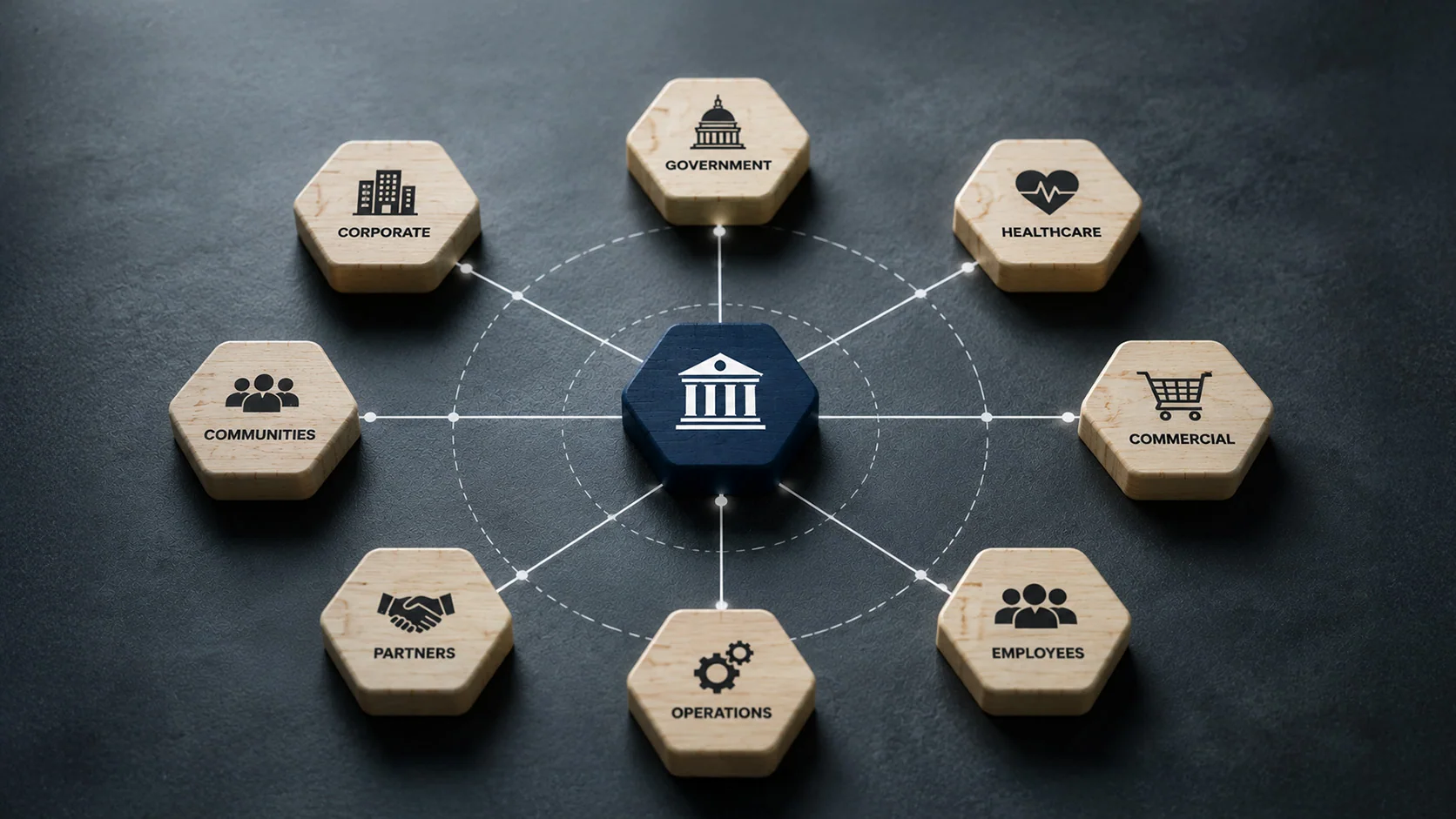
Government institutions, healthcare organizations, universities, corporations, and research centers often serve highly diverse stakeholder groups.
These stakeholders may include:
- Employees and leadership teams
- Customers and citizens
- Patients and healthcare professionals
- Researchers and academic communities
- Policymakers and regulators
- Partners and donors
- Media organizations
- The broader public
Each group possesses different expectations, levels of knowledge, information requirements, and emotional needs.
As a result, organizations must continuously balance adaptation with consistency.
Communication cannot be identical for every audience.
However, neither can it become entirely independent.
Strong organizations adapt their messages while preserving a coherent institutional identity, common values, and shared narrative across all stakeholder groups.
Departments Should Express The Brand, Not Reinvent It
One of the most common challenges within complex organizations is the tendency for departments, programs, or initiatives to create separate identities.
This often happens for understandable reasons. Teams seek visibility. Programs require differentiation. New initiatives wish to demonstrate innovation or autonomy.
Yet excessive independence can unintentionally weaken the institution as a whole.
When every department develops its own visual language, messaging framework, or communication style, stakeholders begin to perceive separate entities rather than a unified organization.
The goal is therefore not uniformity.
It is coherence.
Departments should have the flexibility to communicate their unique roles and objectives while remaining visibly connected to the broader institutional system.
Strong brand systems achieve this balance by allowing controlled flexibility within clearly defined principles.
Brand Governance Becomes Essential
As organizations grow, informal coordination becomes increasingly insufficient.
What once depended on individual relationships, institutional memory, or personal oversight must eventually be supported through governance.
Brand governance provides the structures, principles, standards, and decision-making processes necessary to maintain alignment across organizational complexity.
Effective governance extends far beyond visual guidelines. It helps organizations:
- Define roles and responsibilities
- Establish communication standards
- Clarify approval and decision-making processes
- Create shared tools, templates, and systems
- Enable decentralized execution while preserving institutional coherence
Without governance, consistency depends on individuals.
With governance, consistency becomes scalable.
Systems Create Clarity At Scale
The larger an organization becomes, the more it depends on systems.
Design systems, communication frameworks, content standards, information architectures, and governance models all serve a common purpose: reducing unnecessary variability.
Systems allow organizations to communicate consistently without requiring every decision to be reinvented.
Well-designed systems create value by:
- Improving efficiency
- Reducing duplication
- Accelerating execution
- Strengthening recognition across touchpoints
- Supporting consistent communication at scale
Most importantly, systems create clarity.
In complex environments, clarity is not achieved by simplifying the organization itself.
It is achieved by simplifying how the organization expresses itself.
Internal Alignment Is The Foundation
Complex organizations cannot rely solely on external communication to maintain brand coherence.
Alignment must begin internally.
Employees across departments need a shared understanding of organizational purpose, priorities, values, and communication principles.
When internal understanding is weak, inconsistency becomes inevitable.
When internal alignment is weak:
- Teams begin making isolated decisions
- Messaging diverges across departments
- Stakeholders receive conflicting information
- Institutional trust becomes more difficult to sustain
By contrast, when people throughout the organization share a common understanding of what the organization represents, communication becomes naturally more coherent.
Strong brands are therefore not created through control alone.
They are created through shared understanding.
Complexity Requires Leadership Commitment
Brand coherence within complex organizations cannot be delegated exclusively to communication or design teams.
Leadership plays a decisive role.
Leadership contributes to brand coherence by:
- Determining organizational priorities
- Shaping culture and behaviors
- Encouraging collaboration across departments
- Allocating resources strategically
- Reinforcing institutional standards
Without leadership commitment, even the most sophisticated brand systems struggle to achieve organization-wide adoption.
Brand coherence is ultimately a leadership challenge as much as it is a communication challenge.
Because maintaining alignment across complexity requires continuous commitment, not occasional intervention.
Final Thought
Complex organizations will always contain multiple voices, priorities, initiatives, and stakeholder groups.
The objective is not to eliminate this complexity.
It is to organize it.
The strongest organizations do not force every department to communicate in exactly the same way.
Nor do they allow every department to operate independently.
Instead, they build systems that create coherence without sacrificing flexibility.
Because as organizations grow, complexity is inevitable.
Fragmentation is not.