Introduction
Many organizations invest heavily in branding. They commission logos, redesign websites, produce marketing materials, launch campaigns, and develop a wide range of visual assets intended to strengthen recognition and support communication objectives.
Yet despite these investments, many organizations continue to experience inconsistency.
Presentations look different from reports. Campaigns feel disconnected from the website. Events adopt their own visual language. Social media content lacks coherence. Departments create materials independently. Over time, communication becomes fragmented, and the organization begins to appear less unified than it actually is.
The problem is rarely a lack of design.
More often, it is a lack of systems.
Many organizations unknowingly accumulate design assets over time without establishing the structures necessary to connect them. As a result, branding becomes reactive rather than strategic, producing outputs rather than enabling organizational coherence.
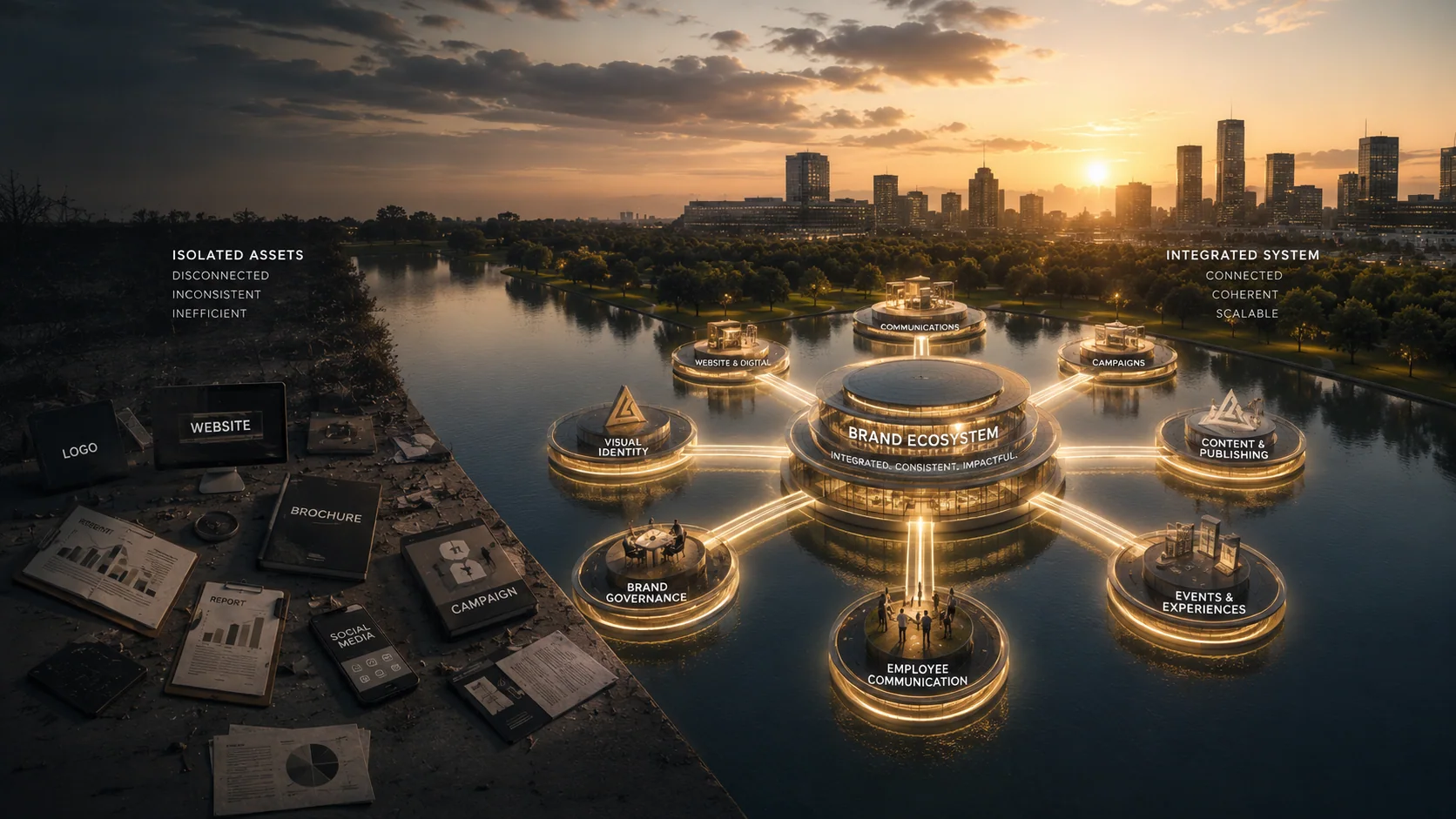
Organizations frequently approach branding as a collection of individual assets rather than as an interconnected ecosystem. Consequently, each new communication need is treated as a separate project rather than as an extension of a larger strategic framework.
Strong brands are not built through isolated assets.
They are built through ecosystems.
Assets Communicate. Ecosystems Coordinate.
Individual brand assets undoubtedly create value.
A logo supports recognition. A website enables engagement. A report communicates information. A campaign generates awareness.
However, assets alone cannot create coherence.
Without an overarching system, even well-designed assets can produce inconsistent experiences when developed independently.
A brand ecosystem ensures that every touchpoint works together to communicate a unified institutional narrative.
Rather than asking, "How should this individual piece look?", organizations begin asking a more strategic question:
"How does this piece contribute to the broader communication system?"
This shift fundamentally changes the role of branding.
Branding evolves from designing artifacts to designing relationships between artifacts.
Fragmentation Is The Natural Outcome Of Growth
As organizations expand, communication complexity increases.
New departments emerge. Additional initiatives are launched. Communication channels multiply. New audiences appear. Specialized teams begin producing content independently.
Without shared systems, fragmentation becomes almost inevitable.
Common symptoms often include:
- Multiple visual styles across departments
- Inconsistent messaging across channels
- Repetitive design efforts and duplicated work
- Competing sub-identities and disconnected initiatives
- Varying quality standards across communication materials
- Difficulty maintaining consistency as the organization grows
In many cases, these inconsistencies do not occur because teams lack competence.
They occur because teams lack a common framework.
Ecosystems Create Coherence Across Touchpoints
Every interaction contributes to brand perception.
Stakeholders rarely experience organizations through a single channel. Instead, they encounter institutions through a series of interconnected touchpoints over time.
These touchpoints may include:
- Websites and digital platforms
- Reports and publications
- Presentations and executive communication
- Campaigns and social media
- Events and conferences
- Signage and environmental graphics
- Customer or service experiences
- Internal communication systems
When these experiences feel connected, people perceive the organization as coherent, credible, and trustworthy.
When they feel disconnected, uncertainty emerges.
Brand ecosystems reduce this uncertainty by creating recognizable patterns across every interaction.
Systems Enable Both Consistency And Flexibility
One of the most common misconceptions about brand systems is that they restrict creativity.
The opposite is often true.
Strong ecosystems do not impose rigid uniformity. They provide principles, structures, and shared standards that enable teams to communicate consistently while adapting to different contexts.
An effective ecosystem establishes:
- Shared visual principles
- Communication standards
- Design systems and reusable components
- Content frameworks and messaging structures
- Governance processes and decision-making guidelines
- Rules for adaptation across departments and initiatives
This approach allows organizations to maintain coherence without sacrificing flexibility.
Consistency should never mean sameness.
It should mean alignment.
Brand Ecosystems Function As Organizational Infrastructure
The most mature organizations no longer view branding as a collection of communication materials.
They view it as infrastructure.
Much like operational systems, governance structures, or digital platforms, brand ecosystems provide the organizational framework that enables communication to function efficiently and consistently at scale.
Without infrastructure, every new initiative requires teams to reinvent processes, redesign components, and reinterpret standards.
With infrastructure, organizations can respond more quickly, communicate more coherently, and scale more effectively.
In this sense, brand ecosystems do not merely support communication.
They support organizational performance.
Governance Sustains The Ecosystem
Brand ecosystems cannot rely solely on documentation.
They require governance.
As organizations grow, maintaining coherence becomes increasingly difficult without clearly defined roles, responsibilities, and decision-making processes.
Governance helps organizations:
- Clarify ownership and accountability
- Define approval processes
- Establish quality standards
- Support cross-functional collaboration
- Ensure long-term consistency across evolving communication needs
Without governance, ecosystems gradually deteriorate into disconnected assets.
With governance, ecosystems remain resilient and scalable.
Internal Alignment Is Essential
The strongest brand ecosystems are not built exclusively through design.
They are built through shared understanding.
Employees across the organization must understand not only how the brand should appear, but also what the organization represents, how it communicates, and why consistency matters.
When internal alignment is weak:
- Departments create independent solutions
- Messaging diverges
- Communication becomes fragmented
- Stakeholder experiences become inconsistent
When alignment is strong, coherence becomes easier to sustain because people make decisions based on common principles rather than individual preferences.
Strong ecosystems therefore begin inside the organization before they become visible outside it.
Ecosystems Create Long-Term Organizational Value
Integrated brand ecosystems deliver benefits that extend far beyond aesthetics.
They improve efficiency by reducing duplication. They accelerate execution through reusable systems. They strengthen recognition across touchpoints. They simplify onboarding. They support organizational growth.
Most importantly, they strengthen trust.
People develop confidence when organizations communicate consistently across time, channels, and experiences.
This consistency creates familiarity.
Familiarity creates trust.
And trust creates long-term brand value.
Final Thought
Organizations do not communicate through logos alone.
They communicate through entire ecosystems of experiences, interactions, systems, and relationships.
The strongest brands understand that individual assets matter.
But systems matter more.
Individual assets may attract attention.
Ecosystems create coherence.
And in complex organizations, coherence is often the foundation upon which trust, efficiency, and long-term reputation are built.
Because stakeholders do not experience organizations as isolated design pieces.
They experience them as connected journeys.
And the organizations that intentionally design those journeys are the ones most likely to build clarity, coherence, and enduring trust over time.